|
Crossfire Server, Trunk
1.75.0
|
|
Crossfire Server, Trunk
1.75.0
|
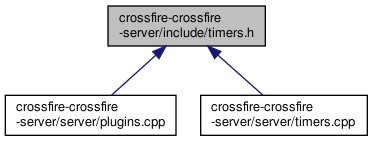
 Include dependency graph for timers.h: This graph shows which files directly or indirectly include this file:
Go to the source code of this file.
Data Structures | |
| struct | cftimer |
| One timer. More... | |
Macros | |
| #define | MAX_TIMERS 1000 |
| Maximum number of timers. More... | |
| #define | TIMER_ERR_ID -1 |
| Invalid timer id. More... | |
| #define | TIMER_ERR_MODE -3 |
| Invalid timer mode. More... | |
| #define | TIMER_ERR_NONE 0 |
| No error. More... | |
| #define | TIMER_ERR_OBJ -2 |
| NULL object, or no EVENT_TIMER handler. More... | |
| #define | TIMER_MODE_CYCLES 2 |
| Timer is in server cycles. More... | |
| #define | TIMER_MODE_DEAD 0 |
| Used to mark a timer as unused in the list. More... | |
| #define | TIMER_MODE_SECONDS 1 |
| Timer is in seconds. More... | |
Variables | |
| cftimer | timers_table [MAX_TIMERS] |
| The actual timers. More... | |
Variables for the custom timers. See page_timers.
Definition in file timers.h.
| #define TIMER_ERR_OBJ -2 |
NULL object, or no EVENT_TIMER handler.
| #define TIMER_MODE_DEAD 0 |
| cftimer timers_table[MAX_TIMERS] |
The actual timers.
Definition at line 37 of file timers.cpp.
Referenced by cftimer_create(), cftimer_destroy(), cftimer_find_free_id(), cftimer_init(), and cftimer_process_timers().
 1.8.17